PRODUCT
Electrical Power & Energy Training Lab
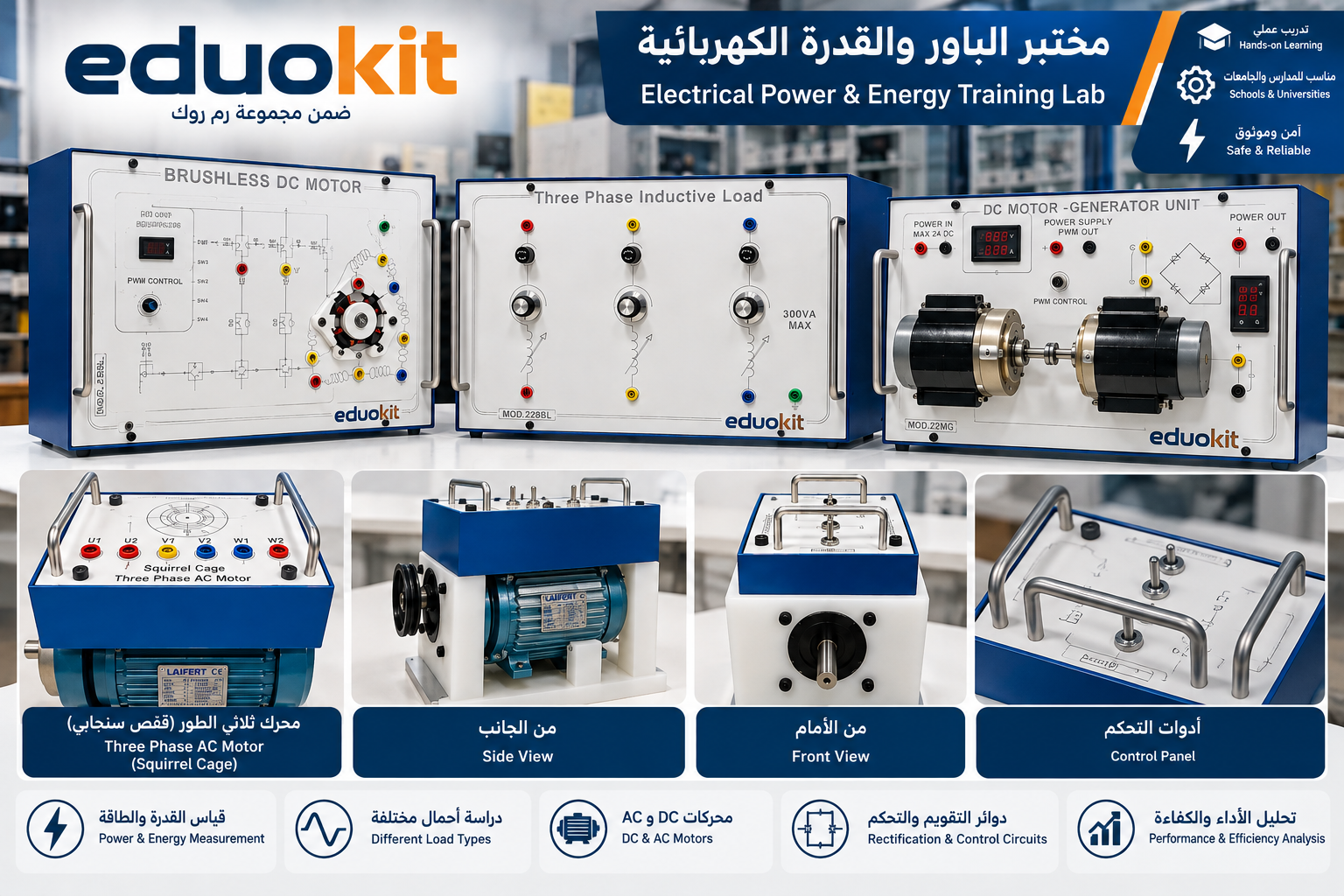
A complete hands-on laboratory for three-phase power, electrical machines, motor-generator operation, inductive loads, rectification, control and practical electrical measurements.
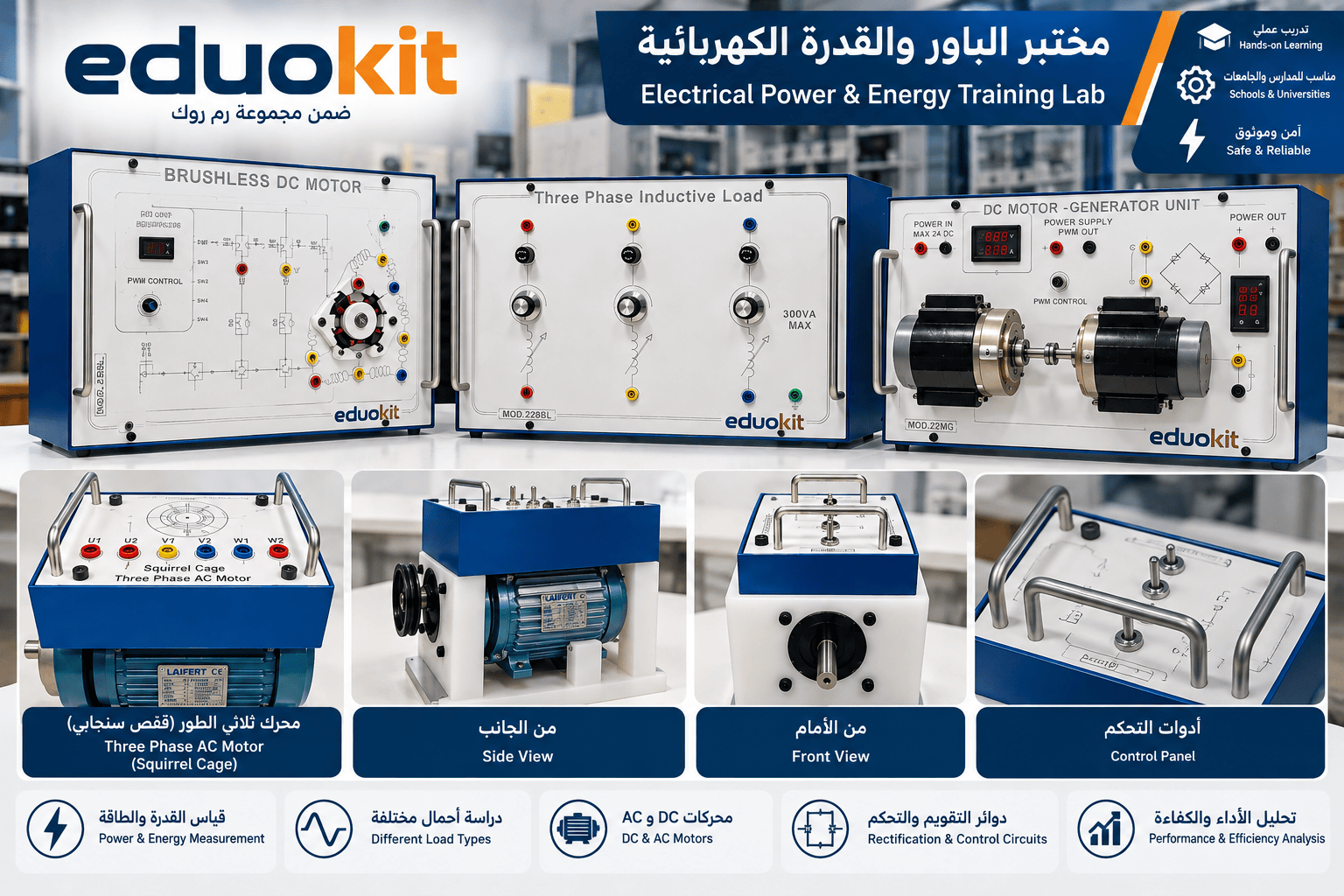
Practical power engineering in one laboratory
The Eduokit Electrical Power & Energy Training Lab is designed to connect electrical-power theory with real equipment. Students work directly with motors, generators, three-phase loads and control circuits, make real measurements, change operating conditions and observe how electrical machines and power circuits respond.
The modular bench-top format makes the system suitable for structured laboratory experiments as well as instructor demonstrations, while clearly labeled terminals and front-panel diagrams help students understand each connection before energizing the circuit.
Main training modules
Three-Phase Power & Loads
Three-phase inductive load modules and protected connection points allow practical study of phase voltages, currents, load variation and the electrical behavior of inductive systems.
Three-Phase AC Motors
Squirrel-cage induction and synchronous-machine trainers provide direct access to motor terminals so students can study wiring, rotation, operating behavior and machine characteristics.
Transformer Training
Three-phase transformer experiments support practical study of input/output relationships, phase connections and voltage transformation.
DC Motor–Generator Unit
A coupled motor-generator assembly enables experiments on electromechanical energy conversion, generation, loading and speed-related behavior.
Brushless DC Motor Trainer
BLDC training with PWM control gives students a practical way to study electronic motor control, commutation and speed regulation.
Rectification & Control
Rectifier and control circuits allow students to follow the conversion between AC and DC and relate switching and PWM control to machine operation.
Typical experiments and learning outcomes
- Measure voltage and current in practical AC and DC power circuits.
- Study three-phase systems and the effect of changing inductive load.
- Identify and connect squirrel-cage, synchronous and brushless DC machines.
- Investigate motor direction, speed control and operating response.
- Study motor-generator energy conversion and generator output behavior.
- Perform three-phase transformer experiments and compare input/output values.
- Study rectification, DC conversion and PWM-based motor control.
- Compare measured results with theoretical calculations and circuit diagrams.
The laboratory is suitable for universities, technical colleges, vocational schools, electrical-machine laboratories and industrial training centers that require real components and hands-on power engineering experiments.
Eduokit • Practical Engineering Training Equipment • RumRock Group